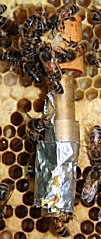
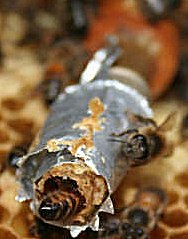
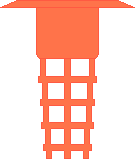
If a queen cell is introduced into a colony that is queenless or has only just been made so, there are queen pheromones circulating that tells the colony they have a queen and don't need a queen cell, so they destroy it. Well, that's humanising the situation a bit, but is what we think the bees are thinking. The cocoon in a queen cell is thicker at the bottom of the cell, making it tougher for the bees to chew, so if they wish to destroy it, they chew into the cell from fairly high up the side wall and remove the contents. To stop the bees destroying the Q/C in this way we protect it, so they can't get at it.
I think to be safe, you need at least 12 hours queenlessness before putting an unprotected Q/C in a colony, but 24 is probably better. You can sometimes get away with less than this, but why risk a potentially good queen?
There are many methods and types of protectors, with a small selection here. I have noticed the suppliers are now often selling in quantities of 10, where previously they were sold singly. I think that probably reflects the fact they are small and easily lost.
Many of these items also appear on the Plastic Bits page, but there are others here that are not made of plastic.
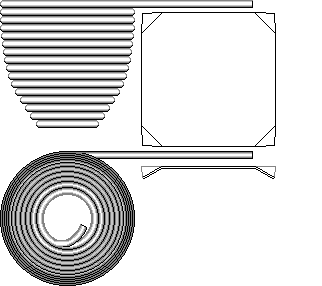
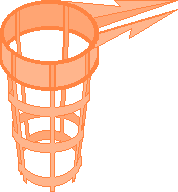
Spiral wire protector
This is a simple and traditional method... It consists of two parts, the coil of wire and a square of tinplate that has its corners bent down at a slight angle. The tinplate can be slid in between the cell. If a cell has been formed on a plastic cell cup or some other substantial base then the tinplate can be left out.
The coils are pulled out slightly when used, but care should be taken to ensure that the gaps between turns are less than a wire thickness and are even all the way down the cell. The stub of wire that sticks out is pressed into the comb surface to anchor the device. As the diameter is rather more than a bare queencell it may be prudent to crush a few worker cell flat to the midrib to ensure that adequate numbers of workers are able to surround the cell in order to maintain the temperature.

Spiral wire protector in use
The drawing at right shows the slightly expanded coils and the tinplate closure plate in position.
Queen cells are much narrower and do not have the same shape as the internal profile of the spiral. Be careful not to rattle the cell about inside the protector especially if it is several days until emergence is expected.
This type has been superseded by the plastic protectors.
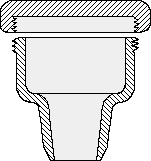
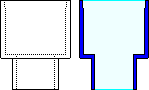
Perret-Maisonneuve cup
This is a solidly made and precision engineered item that has a screw on lid. They are a marvel of Victorian design and, when polished, they are a joy to look at, but they are no better than any of the plastic types.
The depiction here has been redrawn from a Wedmore original, but shows the same style.
This style of cup can be used in conjunction with a tinplate 'cookie cutter' to house small portions of comb, in a similar fashion to cellpunching.